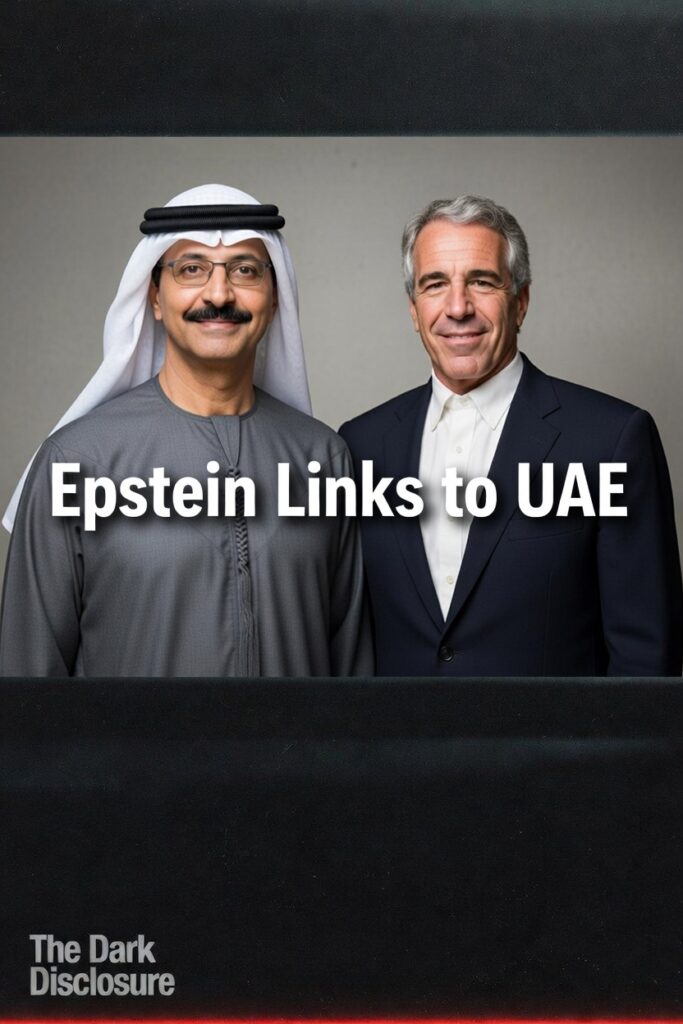
For years, they hid his name. Now we know why.
When the first batch of Epstein files dropped, one short email stopped everyone cold. It wasn’t the longest message. It wasn’t the most graphic. But it was the one that made people gasp and immediately ask: Who sent this?
“Where are you? Are you okay? I loved the torture video.”
The content was horrifying enough. But the mystery made it worse. The sender’s name was completely redacted—blacked out like a state secret, like something too dangerous for the public to know.
For months, we speculated. We guessed. We wondered what kind of person sends that message to a convicted sex offender.
Now we know.
The name is Sultan Ahmed bin Sulayem. And once you understand who he is—what he controls, who he answers to, what flows through his ports—you’ll understand why they worked so hard to keep him hidden.
This isn’t just another name on a list. This is the key that unlocks a whole new dimension of the Epstein network. A dimension involving governments, logistics, diamonds, and power so enormous it operates above the law.
Welcome to the real story.
Who Is Sultan Ahmed bin Sulayem? The Man They Tried to Bury
Let’s start with the basics, because they’re staggering enough.
Sultan Ahmed bin Sulayem is the longtime chairman of DP World, one of the largest logistics and port operating companies in the world . DP World is owned by the government of Dubai—meaning bin Sulayem doesn’t just answer to shareholders. He answers to a ruling family, a emirate, and a global empire of shipping infrastructure .
Under his leadership, DP World has grown into a behemoth that controls ports on every continent, managing everything from container terminals to economic zones. If goods move across an ocean, there’s a decent chance they pass through a facility bin Sulayem controls .
But that’s just his day job.
Bin Sulayem is also a regular attendee at the World Economic Forum in Davos , rubbing shoulders with the same global elite who populated Epstein’s little black book. He sits at the intersection of government power, corporate might, and international finance. He’s not just wealthy—he’s systemically important to the functioning of global trade.
And according to the newly unredacted Epstein files, he was extremely close to Jeffrey Epstein.
We’re not talking about a single meeting or a passing acquaintance. The documents contain thousands of mentions of bin Sulayem . Thousands. That’s not casual contact. That’s proximity. That’s a relationship.
The question is: What kind of relationship? And why did someone work so hard to keep his name secret?
The Emails: What They Actually Wrote to Each Other
Now we get to the evidence—because without it, this is just speculation.
The released correspondence between bin Sulayem and Epstein reveals a pattern that should disturb anyone who reads it. They shared business contacts. They exchanged personal stories. They communicated in the casual, unguarded language of men who believe consequences don’t apply to them .
But it’s the tone that matters most.
Bin Sulayem’s emails include explicit bragging and, most damningly, dehumanizing references to women . The language matches the broader Epstein correspondence—men speaking about human beings as objects, as playthings, as resources to be used and discarded .
To be clear: There is no evidence in the publicly released files that bin Sulayem committed a crime. That’s important to state. But the absence of criminal charges isn’t the same as innocence. It’s the absence of accountability—a pattern we’ve seen repeated across the entire Epstein network.
What the emails do prove is that bin Sulayem operated comfortably inside Epstein’s world. He wasn’t a dupe or a victim. He was a participant in the same culture of wealth and access that protected Epstein for decades.
And then there’s the email that raises even more questions.
The DNA Kits: Why Send Ancestry Tests Through Epstein?
One of the most bizarre revelations in the bin Sulayem files involves 30 ancestry test kits.
According to the documents, bin Sulayem arranged for these kits to be shipped to Epstein’s Manhattan mansion . From there, they were allegedly intended for Sheikh Mohammed bin Rashid Al Maktoum, the ruler of Dubai and the prime minister of the United Arab Emirates .
Emirates Airline later collected the kits from Epstein’s residence .
Let that sink in. The ruler of Dubai—one of the most powerful men in the Middle East—was supposedly having his DNA shipped through the home of a convicted sex offender.
Why?
The official story is that the order was ultimately cancelled due to US shipping restrictions . But the fact that it was even attempted raises obvious and disturbing questions. Why route genetic material through Epstein? Why involve him in something so sensitive? What did Epstein gain from being the middleman for a head of state’s DNA?
And perhaps most importantly: Who else’s DNA passed through that mansion?
We may never know. The records are sealed, redacted, or simply destroyed. But the pattern is clear: Epstein’s home wasn’t just a playground for the powerful. It was a clearinghouse—for information, for favors, for leverage.
The Diamonds: What Was Locked in That Safe?
Here’s where the story shifts from personal scandal to geopolitical intrigue.
When federal agents raided Epstein’s New York mansion in 2019, they made a curious discovery inside a locked safe: loose diamonds .
Not jewelry. Not rings or necklaces. Just raw, unset diamonds, sitting there like currency.
Dubai, where bin Sulayem operates, is one of the world’s largest diamond trading hubs . Billions of dollars in rough and polished stones pass through the emirate every year. And DP World, bin Sulayem’s company, controls the ports and logistics infrastructure that make that trade possible .
Logistics equals leverage.
If you control the ports, you control what moves through them. If you control the diamond trade, you control one of the most opaque and valuable markets on earth. And if you’re tight with a man like Epstein—a man who collected secrets the way others collect stamps—you have a way to move value that leaves no paper trail.
Again: This doesn’t prove bin Sulayem did anything illegal. But it explains why proximity matters. It explains why a logistics titan would cultivate a relationship with a convicted sex offender. It explains why Epstein’s safe contained diamonds from a region bin Sulayem dominates.
And it explains why someone worked so hard to keep bin Sulayem’s name redacted.
The Network: What They Actually Built Together
The biggest mistake people make about the Epstein files is treating them as a single story about one bad man. They’re not. They’re a map of something much larger: a shadow network that operates above the visible system.
Look at the elements we’ve uncovered just in this one relationship:
- A government-owned logistics company controlling global ports
- A ruler’s DNA routed through a sex offender’s home
- Loose diamonds in a safe
- Thousands of emails between powerful men
- Dehumanizing language about women
- A name redacted for years
These aren’t random pieces. They’re architecture.
Bin Sulayem and Epstein weren’t just friends. They were nodes in a network that transcended nationality, religion, and ideology . The common thread wasn’t shared values or even shared interests—it was wealth and access .
Deals made through private relationships rather than open markets.
Influence traded quietly instead of transparently.
Power exercised without accountability.
This is what the Epstein files actually reveal. Not just crimes, but a system. A way of operating that allows the ultra-wealthy to move through the world without the rest of us ever knowing what they’re doing.
The Cover-Up: Why His Name Stayed Hidden
Which brings us back to the redaction.
For years, that email sat in the files with the sender’s name blacked out. For years, researchers and journalists speculated about who could be important enough to protect. For years, the public saw only: [REDACTED] .
Why?
Because bin Sulayem isn’t just some random rich guy. He’s the chairman of a state-owned enterprise. He represents the government of Dubai. His exposure would mean diplomatic complications, business disruptions, and questions that powerful people on multiple continents would prefer not to answer .
The redaction wasn’t about protecting an individual. It was about protecting a system—the same system that allowed Epstein to operate for decades, that allowed his friends to escape accountability, that allows the ultra-wealthy to live by different rules than the rest of us.
And now the name is public. The redaction is gone. We can finally ask the questions they didn’t want asked.
The Questions That Remain
But naming bin Sulayem is just the beginning. The real work is still ahead of us.
- What did bin Sulayem know about Epstein’s crimes? The emails show proximity, but proximity isn’t proof. We need investigators willing to ask the hard questions.
- What was the purpose of the DNA kits? Why involve Epstein in something so sensitive? Who else’s genetic material passed through that network?
- Where did the diamonds come from? And where were they going? Loose diamonds are the ultimate untraceable currency. What were they buying?
- Who else is still redacted? Bin Sulayem’s name is out, but the files are massive. How many other powerful people remain hidden behind black bars?
- Why did the system protect him? The redaction wasn’t automatic. Someone made a decision to hide bin Sulayem’s name. Who? And what did they get in return?
These questions aren’t rhetorical. They’re the next steps in an investigation that’s only just beginning.
The Blood on Their Hands
There’s blood in this story too—not just metaphorical blood, but the blood of victims.
Every email, every diamond, every DNA kit represents a world where young women and girls were trafficked, abused, and discarded. The powerful men in Epstein’s network didn’t just stand by while crimes happened. They participated in the culture that made those crimes possible. They laughed at the same jokes. They shared the same language. They protected the same secrets.
Bin Sulayem may never face charges. He may continue running DP World, attending Davos, and operating inside the elite circles he’s inhabited for decades. The system may protect him the way it always has.
But we don’t have to forget.
We don’t have to let his name disappear back into the redacted darkness. We don’t have to pretend that “thousands of mentions” means nothing. We don’t have to accept that powerful people get a pass while victims rot in unmarked graves.
The Only Way Forward
Here’s what we do:
We share the truth. We keep talking about bin Sulayem, about the diamonds, about the DNA kits, about the ports he controls and the power he wields. We refuse to let this story die the way so many others have died—smothered by inattention, buried by the next scandal, erased by the passage of time.
We demand that journalists ask the hard questions. We demand that prosecutors follow the evidence wherever it leads. We demand that the remaining redactions be lifted, that the remaining names be exposed, that the remaining secrets be dragged into the light.
And most of all, we remember.
We remember that the Epstein files aren’t just a collection of documents. They’re a weapon—a weapon against the shadow network that thinks it’s above the law. Every name we learn, every connection we trace, every story we tell is a blow against that network.
Sultan Ahmed bin Sulayem is just one name. But his exposure proves something crucial: They can’t hide forever.
The redactions are falling. The secrets are spilling out. And the more we learn, the closer we get to the truth they’ve spent decades burying.
Keep digging. Keep sharing. Keep fighting.
Because the network is still there. The power architecture is still standing. And until we dismantle it completely, they’ll keep operating—above the law, beyond accountability, hidden behind redacted names.
But now we know one of those names.
And we’re not going to forget it.
Discover More from The Dark Disclosure
If this article opened your eyes, wait until you see what else we’ve uncovered. The Epstein files are massive, and we’re only beginning to understand what they contain. Subscribe to The Dark Disclosure for exclusive investigations you won’t find anywhere else.
The truth is coming. One redaction at a time.
Discover more from The Dark Disclosure
Subscribe to get the latest posts sent to your email.